Digital plotting/cutting machines

Digital plotting/cutting technology stands to offer solid benefits to marine fabricators, many of whom may be struggling to address labor shortages and other production challenges. Even so, some of these machines come with hefty price tags.
As such, whether buying a table for the first time or adding another one to your floor, thoroughly research what’s available and identify those options that best meet your requirements, resources and future aspirations.
Efficiency gains are significant
Before Shane Cossette, president of TRS Industries in Fargo, N.D., added his two cutting tables, he and his employees had to measure every job by hand, marking and cutting with pen and scissors. More sizeable projects had to be laid out on the floor.
“Some larger multipiece jobs could be stack-cut, but that was only if we needed multiple pieces that were the same,” he says. “We used several upright multi-ply cutters, which were efficient on some of the jobs we made.”
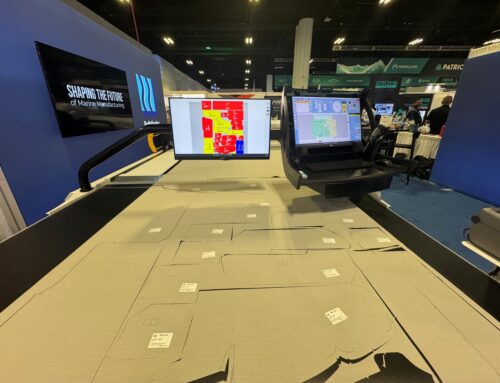
But in 2011, the company purchased a static cutting table, adding a conveyor cutting table in 2024. Now the shop uses both machines for nearly everything it builds, cutting and marking most of the projects before welding or sewing, says Cossette. The addition of a conveyor table has had a significant impact on efficiency, as static machines require manual loading/unloading of material, while conveyors use a belt to move materials.
“The accuracy and speed have been a game changer for this area of our production,” he says. “Having the ability to cut and mark high quantities of patterns simultaneously creates a noticeable time savings.”
When Chicago Marine Canvas opened in 2012, the Illinois-based producer of engineered textile products initially relied on a single automated plotter to create patterns and drawings, also using this as a sewing table, says company president Vince Innocenzi. But as the business took off, along with the need to ramp up production speed, he and his staff realized it was time to invest in an actual cutter.

In 2020, Chicago Marine Canvas traded in the plotter for a plotter/cutter that could mark and cut. In 2021, the shop added a multi-tool cutting table that can mark, cut and punch holes into fabric, purchasing this one used through an auction “at a fraction of what it would have cost new,” says Innocenzi.
He wasn’t sure it would work when he and his installer raced to Pennsylvania to dissemble, load and cart the machine home. But once they got it back to Chicago and reassembled it, to their amazement, they found the table did work.
“We use both machines for all types of projects,” Innocenzi says. “We cut all different types of fabrics — acrylics, PVC, isinglass, upholstery vinyls and leather. We use the plot function to draw on wood, plastics, polycarbonate and acrylics. Both tables have increased production. There is no way a person could cut as fast as the table.”

Critical considerations
When Cossette began looking at cutting tables, he sent fabric to three companies to discover which machine would work best with what his company uses the most. The companies cut the fabric and sent it back to Cossette; he used their feedback and accuracy to decide which machine was best for his shop and who would be easiest to work with.
“I quickly learned that the fabric that was toughest for us to cut was easy for this type of machine to cut,” Cossette says.
Space became a factor when adding a second table — one reason why he opted for a conveyor, since this took up less room.

That’s an important consideration, says Eric Sevy, automation consultant for Autometrix, a digital static and conveyor cutters manufacturer headquartered in Grass Valley, Calif. He explains that conveyors typically do require less space, but fabricators should take into account that either table style is not easily moved once in place. This is why thinking through the shop’s workflow is key for optimal long-term placement.
Most tables can be retrofitted to be longer, Sevy says, but going wider isn’t an option.
“Recognizing the widest thing you might ever cut using the table is very important,” he explains. “This may not even be the widest thing you’re currently cutting. Build the table not for now but for the vision you have for your shop five years down the road.”

It’s not just the table’s size, says Trevor Stevenson, president of Eastman Machine, a designer and manufacturer of digital conveyor and static cutting systems/flatbed cutters based in Buffalo, N.Y. Understanding how the material moves through the shop — and consequently the space required for loading the raw materials and unloading the finished parts — is essential to keep operations moving smoothly and efficiently, he adds.
Along with floor space, the materials most often used, and those materials’ thickness and roll widths, marine fabricators should evaluate the types of projects they produce. Consider whether the shop’s projects are largely one-offs or repeat work, says Chris Gilmartin, sales manager, North America, Pathfinder Cutting Technology LLC. Labor availability is another important calculation he mentions.
“Many businesses entering automation focus heavily on up-front capital costs. It is understandable. However, labor costs rise year after year. Capital equipment does not. Choosing a system based solely on lowest initial price can limit long-term efficiency,” Gilmartin explains. “The return should be measured over years of operation, not weeks of installation.”

Headquartered in Indianapolis, Pathfinder designs and manufactures conveyorized computer numerical control (CNC) knife cutting systems, says Gilmartin, who favors conveyors for their reduced materials handling time, smaller footprints and productivity, in addition to other features.
CNC cutting systems should be simple, durable and integrate with the shop’s workflow, says Gilmartin, adding that “open-file compatibility is essential,” as this gives fabricators full control over their data. Ease of use is crucial since it’s unlikely that marine fabricators will have a dedicated CNC technician on staff.
The equipment should require minimal maintenance and adjustments, ideally much of which the manufacturer could guide remotely.
“Equally important is the level of support behind the machine,” says Stevenson. “You need a partner that provides strong service and technical support, not just equipment. When something goes down, response time and expertise matters.”

Creating ‘permanent assets’
Automation offers multiple benefits, the most significant of which are consistency and efficiency, says Stevenson. Although plotters/cutters require more investment up-front than manual processes, this is offset by operational gains.
“Fabricators reduce manual layout time, minimize material waste and get repeatable quality across every part,” he says. “This leads directly to better throughput, lower labor dependency and more predictable results. And for many shops, it also creates the ability to scale without sacrificing quality.”
Simply put, these machines eliminate the human error associated with cutting, at the same time allowing fabricators to cut full jobs in minutes rather than in hours, Sevy explains. Digital files provide the ability to quickly duplicate projects without having to repattern or store old patterns, reducing space requirements in the process.

Digitalization transforms patterns and shapes into “permanent assets” that no longer reside solely in a fabricator’s head or a file cabinet, says Gilmartin.
“They become protected intellectual property that can be reused, refined and scaled,” he says. “Once patterns are captured and stored digitally, businesses can increase production without increasing the complexity of their cutting room or relying on additional specialized labor.”
Gilmartin says installation of a CNC cutter typically takes about half a day. Cutting can start immediately even as parameters are being established and fine-tuned for various materials. He explains that with intuitive software and sufficient support, fabricators should quickly become comfortable operating the machine.
Well-designed software can enable fabricators to get up to speed within a matter of days, says Stevenson. But becoming fully efficient often takes longer — several weeks is typical, depending on project complexity. The right support can prove critical in this effort.
“Customers should expect training during installation, ongoing technical support and access to people who understand both the machine and application,” he says. “That combination makes a big difference in how quickly a shop gets real value from the system.”

Getting started
Sevy cautions that patience and persistence are needed. “There’s a learning curve to taking a 3D model and converting it into a usable pattern,” he says. He advises fabricators diligently apply themselves to exploring the software and its capabilities, using it for as many jobs as possible.
Cossette suggests the same. Within two or three days, he had a pretty good handle on operating his newest table. But getting fully proficient on the software took longer, even with strong manufacturer support — which is why he says fabricators should try to run their tables every day.
“It’s very important to have a workload lined up so you can hit the ground running,” Cossette says. “The more you use it, the better you get at the whole process.”

In his conversations with marine fabricators, Gilmartin routinely hears the same three concerns: labor and knowledge retention; capital costs and ROI; and margin pressures due to rising labor and material costs.
“Thoughtful automation addresses all three,” he says. “It reduces reliance on tribal knowledge, improves repeatability and converts craftsmanship into durable digital assets. At some point, a shop will build the same seat or top again. When patterns are digitized, that work becomes leverage rather than repetition. For many marine businesses, digitization is becoming the foundation that allows craftmanship, efficiency and long-term business value to coexist.”
Pamela Mills-Senn is a Seal Beach, Calif.-based freelance writer.
Learn more about how table technology has advanced over the past several years.
ATA member benefits
U.S.- and Canada-based fabricators who are looking for a new machine can access financial assistance through Advanced Textiles Association (ATA) membership. SCL Equipment Finance offers tax advantages, low monthly payments and no financials needed up to $350,000.
Members can take advantage of this benefit by contacting:
Crystal Harrison
SCL Equipment Finance
+1 800 291 8777
crystalg@socalleasing.com
To learn more about ATA and its offerings, visit textiles.org/membership/benefits.