Meeting boater demand in soft enclosures

If you want to keep customers happy, it pays to know in advance what they want. That’s especially true as boaters demand more from their boats; however, challenges abound in meeting those demands.
“The boat enthusiast is a unique customer group,” says Craig R. Zola, vice president of marketing and distribution at Herculite® Products Inc., a fabric manufacturer in Emigsville, Pa., which has specialized in high-performance flexible composite textiles for more than 70 years. Zola is also the chairman of Advanced Textiles Association’s (ATA) Board of Directors.
“Over the years, the boat consumer has seen major advancements in boat technology, like joystick control, digital instrumentation and even gyroscopic stabilizers,” Zola explains. “The boat OEMs have moved away from the beast inboard engines to insanely powerful outboard configurations. Today’s boat consumer wants a sleek design and cutting-edge technology.”

That thinking extends to enclosures.
“These same consumers expect cutting-edge quality and expertise from their enclosure fabricator,” Zola says. “The ‘good enough’ mindset is gone, so there is more attention to product choice and precise detail. The burden falls on the enclosure fabricator to become a master fabricator through programs like Marine Fabricators Association (MFA), selecting the best quality materials available, not overengineering the project and charging appropriately.”

Soft enclosures are challenging
That’s not always easy, fabricators note.
“For me, soft enclosures are one of the most challenging projects,” says Björn Hallier, who operates Bootssattlerei Hallier in Bad Abbach, Germany. Hallier has won MFA Fabrication Excellence Awards for his soft enclosures work.
“The complexity doesn’t lay in how to fabricate,” he says, “but in the perfect fit of your fabric pattern. Every small fault or wrinkle of your pattern is directly transferred as a wrinkle in your roller clear and stays there, visible forever. Hard enclosures forgive a lot of not-so-good patterns, whereas soft enclosures do not do that at all.”
Hallier says he only works on boats in the shop, which is an advantage. “I’m able to fabric-fit and see every small fault,” he says, discussing tricks of the trade. “Especially if you have a complex curvature of a panel, then you need to use darts and seams to 3D-shape the panel to stretch the fabric to get it flat. As a result, you will need to sew the window material in that 3D panel, which wouldn’t lay flat on a table at all.
“You must not be afraid of redoing panels a second or even a third time if you try out new techniques,” Hallier adds. “In the end, it will always pay off. Even if you fail, you at least know that you have to choose a different route next time.”

Quality is important
“We double stitch almost everything — it’s how we reinforce and especially how we overlap and Velcro® all our zips,” Hallier says.
“Even in the heaviest storms, we have never had one customer complaining about any leakage so far — and our customers love that,” he adds. “Though that costs us up to 10 hours extra per enclosure, it really pays off in the long term and word-of-mouth recommendation.”
Long before the fabricator gets their hands on the materials for soft enclosures, the work belongs to the manufacturers and distributors. That means prioritizing quality during the fabric’s inception.
“Strataglass® [a subsidiary that manufactures press polished vinyl sheets] formulations are proprietary and designed to achieve durability objectives for a marine application,” says Zola. “The formulations are tightly controlled, tested and verified using only domestic input supply partners. This controlled quality standard has been in place since the Herculite acquisition in 2015 and is largely responsible for the current brand recognition and popularity.”

‘Good enough’ is not an option
“PVC extruders and coaters around the world all understand the UV and durability targets for the marine environment,” Zola says. “Most companies promote a ‘high-quality’ product. But we have found that many product options in this space, specifically imports, tend to be cost-driven down to ‘good enough’ for the markets they serve. We believe that these options are not ‘good enough’ for Strataglass brands and our customers’ quality expectations. It takes verified quality control through supply chain and through the manufacturing process to meet customer expectations in a market where optical perfection is ultimately the desired result.”
Sometimes, though, a fabricator wants rolled goods because they can take out a roll, use what they need and put the rest back for another job; cost is important but maybe not the main consideration. On the other hand, press polished sheets are favored by those “who want the best of everything,” says Sheldon Cohen, director of marketing for Robeco, based in Golden Bridge, N.Y. Price is not generally much of an issue — if an issue at all.

And sometimes the climate where the boat will operate has a part in dictating what kinds of enclosures might be best, according to Ki-Raphael Sulkowski, an MFA Fabrication Excellence Award winner who operates K1 Marine Trimming in O’Connor, Western Australia.
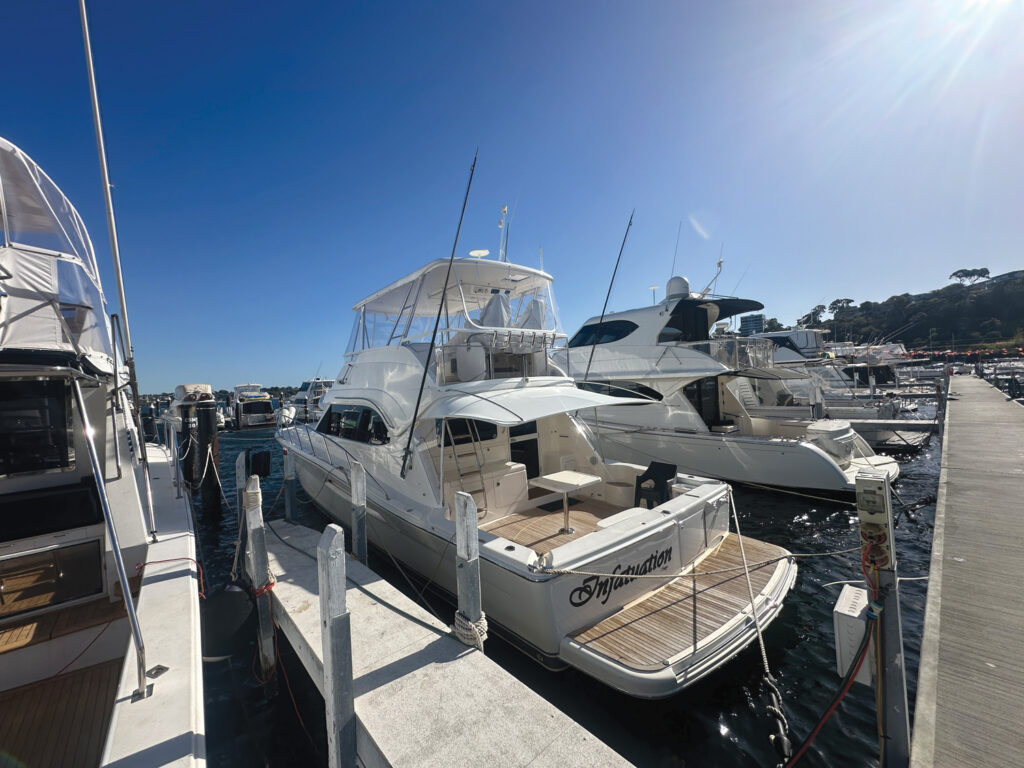
The sea breeze is strong during summer afternoons where Sulkowski’s clients go boating. “Flybridge cruisers are very popular where we operate,” he says. “The strong winds around Perth waters and the islands our clients visit result in a lot of water spray up into the flybridge while the clients are underway. Having the right approach to designing and manufacturing soft, clear enclosures means we can help our clients maximize the use and enjoyment of their boats in all kinds of weather.”

As always for fabricators, what it comes down to is working with the customer to determine and meet their needs. For example, Sulkowski worked with a customer who had a clear enclosure that did not last because of poor quality materials and construction. He said the client agreed with him that a complete redesign of the enclosure — which would require significant improvements on both the design and execution — was the only way to go.
It took design expertise and innovative construction techniques, combined with the best quality materials to ensure the new enclosure would last as long as it should, he says.

Sulkowski adds the client was “thrilled with the installation. … It was everything they hoped it would be and more.”
In the end, that’s all you can ask for.
Jeff Moravec is a freelance writer based in Brooklyn Park, Minn.
SIDEBAR: How much have soft enclosures changed?
Products in the marine fabrication industry may not always change radically, but change they do — improvements draw new customers and provide for higher-quality products.
While soft enclosures have benefited from improved technology, some say change has been minimal.
“The basic requirements for soft enclosures haven’t changed in the last 10 or 15 years,” says Björn Hallier, who operates Bootssattlerei Hallier in Bad Abbach, Germany. “But there are things that are different. A front panel used to be one piece, where it is now three pieces.”
He also says a significant trend is that boaters want additional sun protection due to climate change. “Almost every customer chooses separate side panels made out of Soltis 86 [by Serge Ferrari Group], which can also be used as mosquito gauze,” explains Hallier. “And some also want to have extended shade on the bow.
“Sometimes we had to think out of the box and changed from a normal enclosure with bimini extension to a totally different enclosure that provided the customers suddenly with a twice as big space under the closed enclosure for their bowrider,” he adds.
According to Craig R. Zola, vice president of marketing and distribution at Herculite® Products Inc., Emigsville, Pa., and chairman of Advanced Textiles Association’s Board of Directors, “Enhancements in coating and manufacturing have added greater longevity and usefulness to products like [Herculite’s] Strataglass®. Our flagship feature is the VueShield™ coating. The durability and clarity of the coating is what drives the brand.”
Zola says research is a critical part of Herculite’s work.
“In 2017, durability enhancements were made to the Strataglass coating,” he says. “To understand and benchmark the improvements, tests were performed using a controlled weighted abrasion pad to compare uncoated, competitive coating and enhanced VueShield coating scratch resistance. After 100 passes of the test apparatus, the uncoated vinyl was completely scratched, the competitive coating was mildly scratched and the enhanced VueShield coating remained scratch-free, verifying our modifications.”
Currently, Zola says, polycarbonates and rigid panel enclosures have gained popularity because of their glass-like appearances, but the soft enclosure market remains strong due to its flexibility, stowability and ease of use for the boat owner. “The ability to roll curtain up to enjoy the ocean breeze and easily store the Strataglass enclosure panels remains very practical for most boat configurations.”
SIDEBAR: Four types of vinyl
Sheldon Cohen is director of marketing for Robeco, based in Golden Bridge, N.Y., which has offered quality plastic films and sheeting for a variety of industries for more than 65 years, with a complete range of calendared, extruded and press polished marine-grade products.
Cohen has been with Robeco since 1992 and specializes in transparent PVC for marine windows. He has seen extensive changes in the industry over the years in that many of the vinyls used today are imported and often reflect the quality requirements of the country in which they are produced.
Cohen explains there are four types of vinyl available, with each type designed to satisfy the quality and cost requirements of a specific job:
- Calendared vinyl is a widely used material and is the most cost-effective. However, the process often produces material with blemishes and distortions.
- Laminated vinyl is calendared vinyl that has been laminated in plies to produce a material that is more than .020 gauge. The basic quality and cost considerations are the same as calendared vinyl.
- Extruded vinyl is made via a process that mixes the vinyl and dispenses the sheet/film through a die. This process creates a higher-quality window with few defects or distortion and is a little more expensive. Extruded vinyl is becoming a favorite with many European fabricators.
- Press polished vinyl is a sophisticated laminating process that results in a very high-quality material with outstanding clarity and minimal defects. All vinyls are supplied in rolls except for press polished, which comes in sheets. It is most popular among high-end window fabricators.