Smarter, faster, safer

Marine fabricators are always looking for ways to make their jobs simpler, safer, and more efficient and cost-effective.
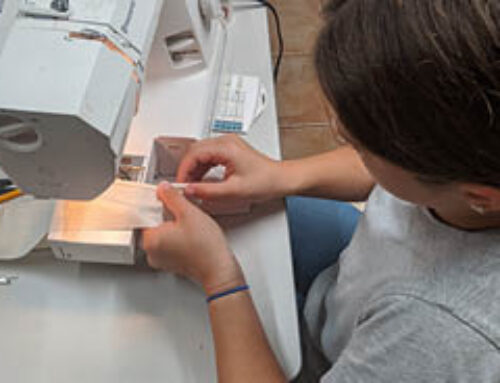
Precise, compact handheld tools and equipment—including snap-fastener installers, hot knives, foam cutters and upholstery tools—are integral parts of a marine fabricator’s day-to-day work.
Many companies are working to enhance these myriad tools in ways that will not only boost fabricators’ productivity but also ensure their safety.

Common tools that make a difference
David Segal, president of Edward Segal Inc., in Thomaston, Conn., says his company offers powered solutions to install snap fasteners and grommets, small pneumatic presses, and larger machines with feeders that can be used in shops.
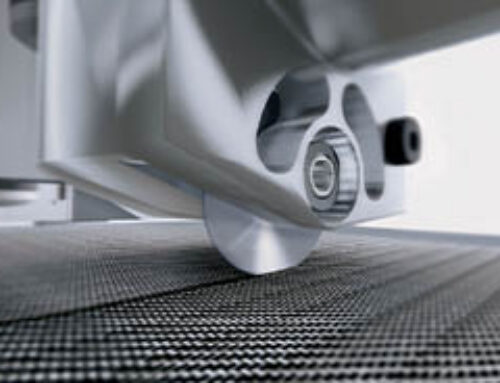
Eastman Machine Company in Buffalo, N.Y., also provides a variety of handheld tools for marine fabrication, including rotary shears, larger round-knife cutting machines and straight-knife cutting machines.
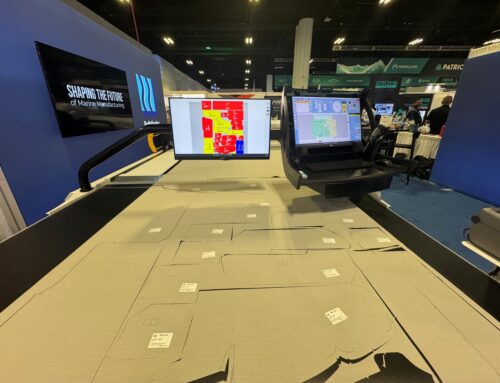
“These machines can cut through the easiest of interior fabrics to some of the toughest fiberglass and composite materials,” says Trevor Stevenson, president, adding the company also offers end cutters for larger panel-type straight cutting as well as small flatbed CNC cutters—which, he notes, “dramatically increase efficiency and accuracy.”
Sailrite® DBA JustWholesale in Columbia City, Ind., offers cordless hot knives with precision-cutting blades among its products. “Having a cordless hot knife is really a great tool for cutting synthetic fabric and sealing the cut edge at the same time,” says Matt Grant, vice president. “For marine canvas work, most material is synthetic.”

He says the company’s Edge Hotknife with a precision-cutting blade includes a foot that allows fabricators to cut on any surface without damaging it. “It is smaller and more precise,” Grant explains, “so cutting circles and slits is much easier. And zipper openings can easily be cut since the foot fits perfectly between the zipper stitch lines.”
JustWholesale also offers drill cutters “where you use a mallet to pound the cutter through the fabric into a rubber block,” says Grant. This technique, he explains, keeps the tools from becoming damaged. The company also provides zipper pliers, which, Grant says “are essential for efficient installation of top and bottom zipper stops for molded tooth and metal zipper chains. They spring open, which makes use far better than common pliers.”
HooVer Products in San Jacinto, Calif., is also focusing on upgraded equipment. “We offer the Pres-N-Snap® tool for installing snaps and grommets into canvas and vinyl,” says company sales rep Laura Hoover. The company also offers a C-4 punch, L-6 punch and AT10M punch for cutting holes in various brands of directional fasteners. “These machines and punches are critical in the marine fabrication industry for setting the most common type fasteners,” Hoover says.

Designing with fabricators in mind
Companies are continuously looking to find ways to upgrade their tools to enhance ergonomics and productivity.
“Many marine fabricators operate small shops,” says Segal, “and do most of their snap installation on the boats themselves.” It’s why, he says, his company’s impact driver is such an alluring proposition. “The right installation tools can reduce the time it takes to put in a snap fastener and leave more time for those operations that really produce revenue.”
When it comes to improved, innovative products, Segal says the company hopes to offer a unique enhancement to two impact drivers that fabricators can use in the shop or on a boat. These items appear on Edward Segal Inc.’s website; however, Segal says neither is currently available “because the manufacturer of the impact driver made changes that precluded the integration of the C-frame head to the driver.” The plan, he says, is to “reintroduce the impact driver installation tool when a compatible driver can be identified.” Right now, Segal says, there’s a waiting list of more than 100 people interested in these products.
“In today’s environment,” says Segal, “it’s critical for businesses to try to maximize the productivity of employees. Automatic grommet or snap fastener tools provide resources so your best employees can get more done every day without experiencing fatigue or pain.”
Hoover agrees. “Our Pres-N-Snap tool and punches are all portable,” she says, “which makes them convenient for working on projects on-site.” That way, she adds, “there’s no need to take your whole project back to the shop to set snaps or grommets. They can be set on the fly right there while on the boat or dock.”
In addition to making tools that are more efficient for fabricators, manufacturers say it’s important that these tools are properly used and well-maintained. “It may be an old cliché, but read or view the operator’s manual or instructions, and make sure anyone who might use it is familiar with its operation as well,” says Segal. He also adds that it’s important to remember that machines always need preventive maintenance.

“Textile-related applications are notorious for spraying fabric residue when holes are punched,” he notes. “This residue can work its way into the machine or accumulate on the feeders and interfere with the gravity feed.”
Stevenson stresses the importance of always having a sharp knife, and Eastman’s knives have built-in sharpeners.
When it comes to the Pres-N-Snap installation tool, Hoover says fabricators can get the most life out of the product by “keeping them clean and oiling them in a few key places to keep them in smooth working condition.” Sometimes, she says, if the tool starts to hang up or get in a bind, “it could be that it just needs a bit of oil on the plunger and inside the frame, or perhaps the handle is a bit worn and needs replacing.” Hoover says all parts of the product are replaceable.
Safety first
Just because many of the tools in the industry are small, it doesn’t mean there aren’t safety concerns associated with them. Small-tool manufacturers and distributors stress the importance of having built-in guards in place, using sharp blades and wearing safety glasses.
“That’s because handheld tools generally don’t have any type of safety device,” says Segal. “Operators [must be] attentive when operating any type of hand tool to protect against injury. It is always easy to be thinking about the next job when involved in a repetitive process.”
Hoover is also an advocate of safety glasses, especially when cutting holes, and she recommends that when making holes with punches, “use a mallet, rather than a hammer. [Use] a rubber mat or the end grain of wood as a backing so as not to damage the punch.”
Grant adds that there are potentially harmful effects from heat-cutting fabric and dust from foam cuttings, but “proper ventilation and use of a respirator [would] mitigate much of the concern.”

What’s new
JustWholesale released a product in December 2024 called the HandyPress®, which Grant describes as “the next level up from something like a Pres-N-Snap, designed to replace other bench-mounted pressers, cutters and punches.” The product comes with six adapters so it can be used with a variety of dies and accessories from other brands.
Hoover says her company has updated its Pres-N-Snap tool with a new handle design that is more ergonomic and easier to use for those with smaller hands. “Pneumatic machines can be great when doing high volume,” says Hoover, “but manual machines are a shining star, offering more flexibility when installing on-site.”
Segal concurs, noting that while pneumatic machines tend to be more powerful and easier to maintain, running them properly requires a quality compressor and an air dryer system. “If not, the machine likely will not function properly and will experience premature wear,” he says.
When it comes to using manual machines, Hoover says it’s important to stay focused and work methodically. “Take your time and be certain the fasteners are placed exactly where you want them, without making errors and damaging a nearly completed project.”
HooVer, she adds, has improved its M2700 rubber ring and offers the newly designed M2400, which, she says, can be used “to easily insert button/caps or eyelet/posts into the dies.”

All these companies are working to continually improve handheld marine tools, and they all have plans to continue developing new products.
“The advantage of being able to innovate is rooted in the fact that most tools used by marine fabricators are small and inexpensive,” says Grant. “The relatively low cost of entry is part of the reason getting into [the marine] business is attractive,” he adds, “although learning the skills to create and sew effectively is another matter.”
Segal says that despite the size of these tools, it’s still a challenge to come up with new products for smaller fabricators. “Innovation requires an investment in research and development, and the result must be a product that is functional, marketable and profitable.”
Stevenson, though, believes Eastman will continue to find ways to improve the tools required for the industry. “We have been in business for 136 years. There is not too much we haven’t seen to be able to provide a solution for in the cutting room.”
Kelly Hartog is a freelance journalist in Los Angeles, Calif.